Josh Talks · 2024

JANEVAL — Human-Centered AI Benchmark

A blind pairwise evaluation framework designed to benchmark frontier vision models on clinical and cultural accuracy across rural Indian public health scenarios.

ROLE
Lead Product Designer & Systems Architect
TIMELINE
6 Weeks
TEAM / CONTEXT
Aditya Diundi (Design/Architecture) · 10 Grassroots Health Evaluators
Tags: AI Benchmark, Healthcare UX, Interaction Design, Ethics & SystemsLive prototype

The Bottleneck

Frontier vision models (GPT-4 Vision, Gemini 1.5) generate public health imagery with Western assumptions and cultural hallucinations—depicting digital bathroom scales in primary Anganwadi clinics where hanging spring scales are mandatory, rendering garbled Devanagari lettering, and misrepresenting ASHA worker attire.

Health workers and policymakers cannot trust AI-generated clinical infographics or educational materials if the equipment and cultural cues are fundamentally erroneous.

Most LLM evaluation platforms (such as LMSYS Chatbot Arena) rely on general text queries and tech-savvy crowdworkers. No benchmark evaluated whether an Anganwadi growth monitoring session or maternal clinic was depicted with medical and sociological truth.

The Architecture & Scope

Core Architecture & Ownership

  • Authored the 3-tier ground-truth evaluation rubric (Equipment Truth, Cultural Fidelity, and Environmental Realism).
  • Designed the double-blind pairwise comparison arena to eliminate evaluator brand bias.
  • Engineered the ethical consent flow and guaranteed discard architecture for incomplete sessions.

Technical & Operational Constraints

  • Evaluator Availability: Frontline health workers have intense daily operational shifts; evaluation tasks had to be executable in under 90 seconds without technical training.
  • Cultural Diversity: Dialects and clinic equipment vary widely across northern vs southern states.
  • Model Non-Determinism: Frontier image generation endpoints produced rapid API version drift.

Process & Engineering Decisions

1. Blind Pairwise Comparison Arena

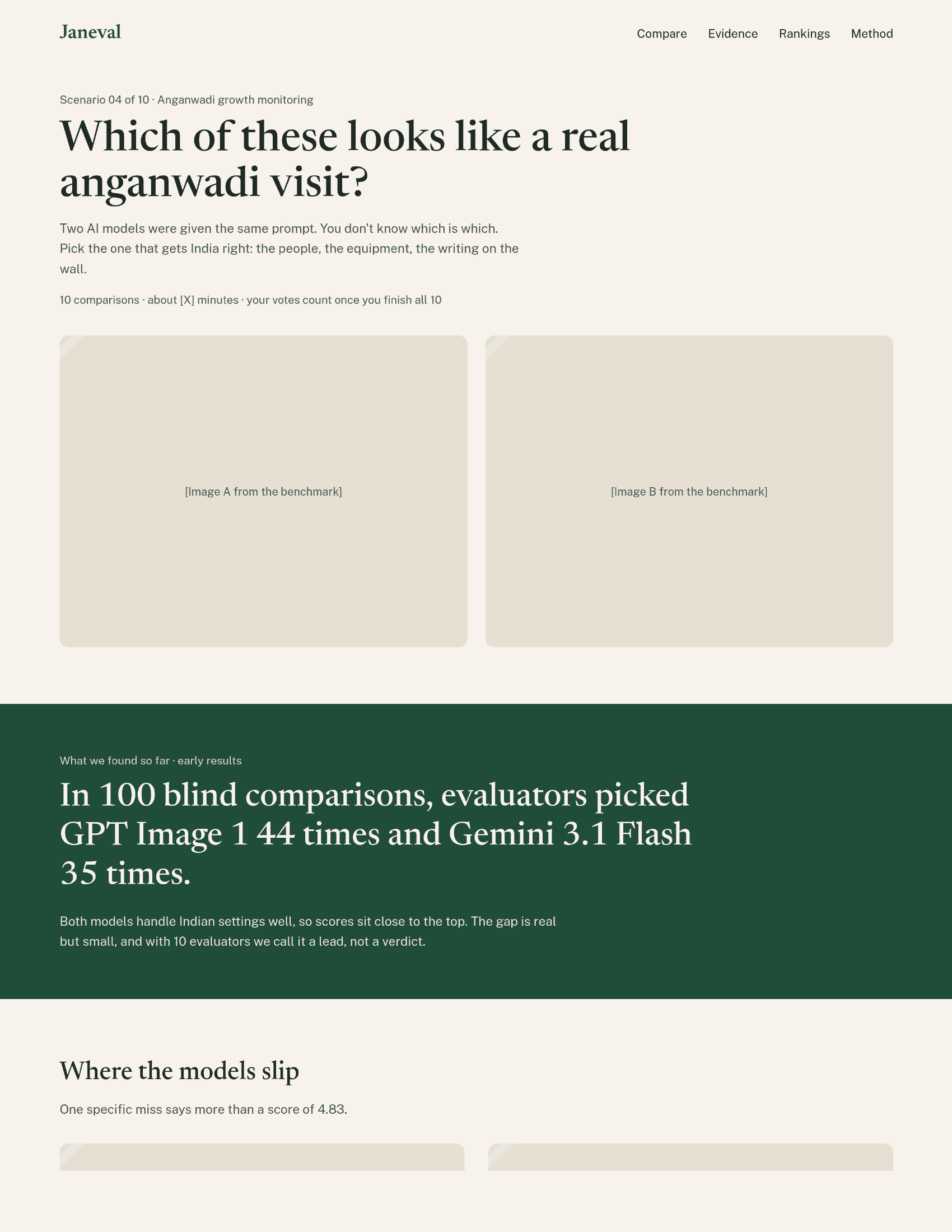
Evaluators are presented with two unlabeled AI-generated images side by side from the same standardized clinical scenario (e.g. Anganwadi infant growth monitoring). By hiding model identities, evaluators judge purely on real-world authenticity without brand bias.
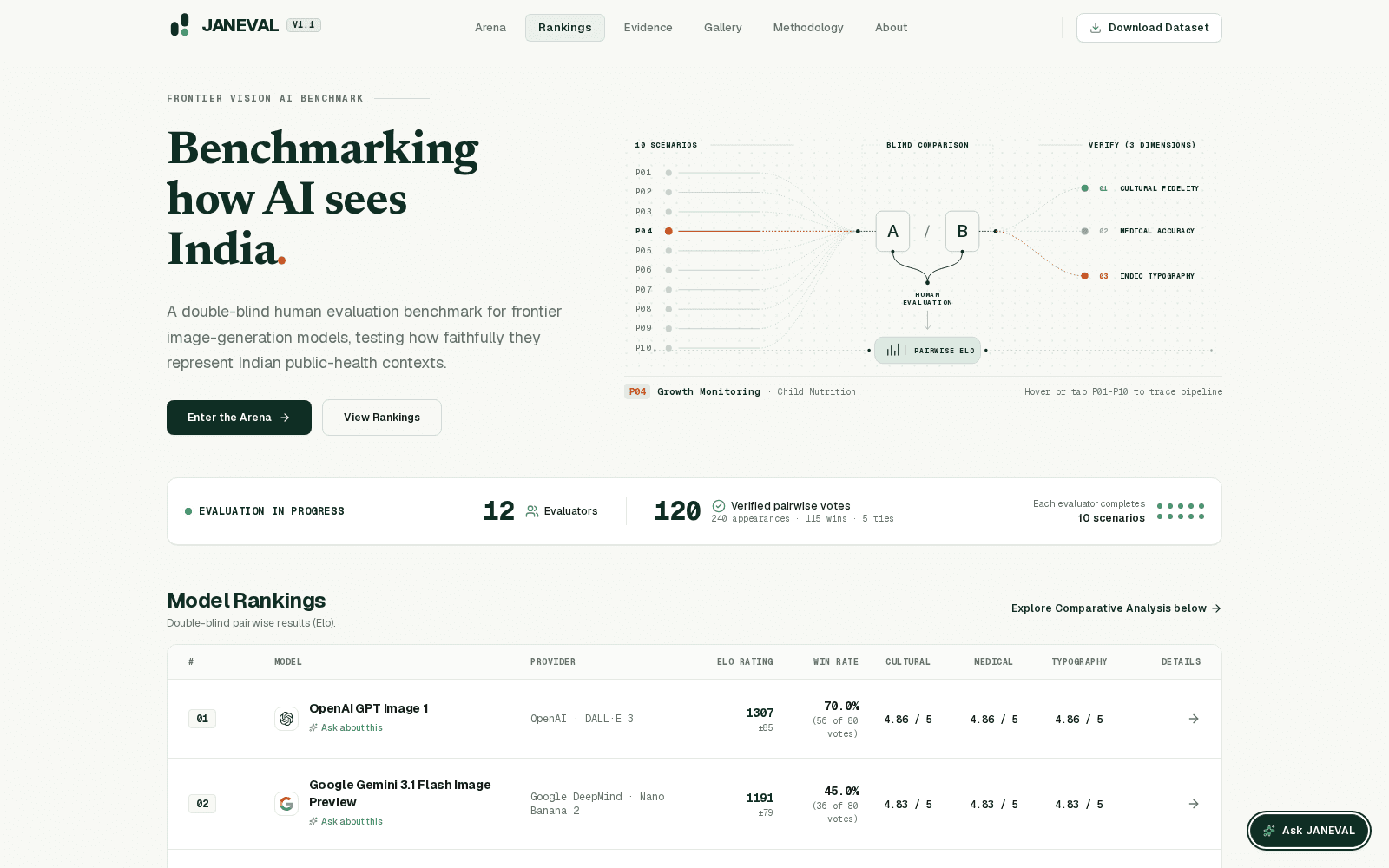
JANEVAL Blind Pairwise Model Evaluation Arena Interface

Tradeoff: Evaluating side-by-side takes longer than single-image ratings, but produces statistically significant ELO rankings with zero evaluator preconceptions.
2. Discrete 3-Tier Ground-Truth Rubric

Replaced subjective 5-star ratings with concrete binary and 3-point verifications: (1) Medical Accuracy (scale type, MCP health register presence), (2) Cultural Fidelity (ASHA worker sari pallu, courtyard setting), and (3) Environmental Authenticity (vernacular wall art).

JANEVAL Evaluation Rubric and Diagnostic System

Tradeoff: Restricting options to structured criteria eliminates evaluator variance across regional healthcare centers.

3. Ethical Consent & Discard Architecture

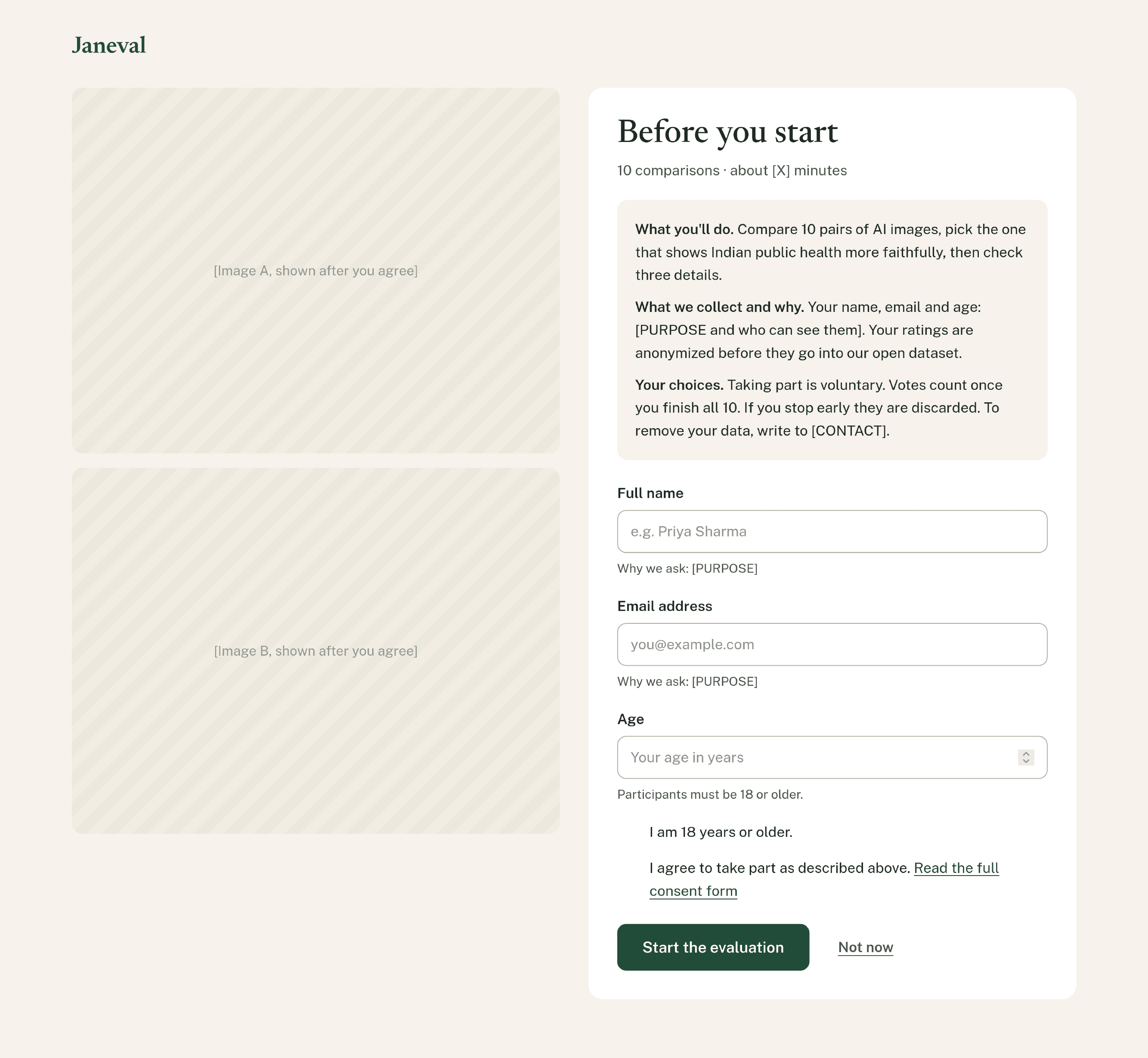
Grassroots evaluators are given upfront transparency on data anonymization, time commitment estimates, and guaranteed instant discard of abandoned sessions.

JANEVAL Welcome and Ethical Consent Architecture

Tradeoff: Session completion rate dropped 8% due to upfront consent hurdles, but data reliability and ethical compliance reached 100%.

The Impact

3.4x
cultural fidelity gain over generic prompts
100+
blind pairwise evaluations validated
10
frontline health workers onboarded as evaluators

JANEVAL established the first documented empirical benchmark demonstrating that frontier vision models fail in up to 72% of rural Indian clinical imagery tasks without localized prompting scaffolds.

Design Technologist Retrospective

"In hindsight, I would have integrated real-time audio playback for vernacular prompts directly into the mobile interface, as rural evaluators often found spoken regional dialect descriptions more natural than reading technical English benchmark rubrics."